

European White Oak vs. Domestic Hardwood: What Justifies the Price Difference for a Bay Area Install
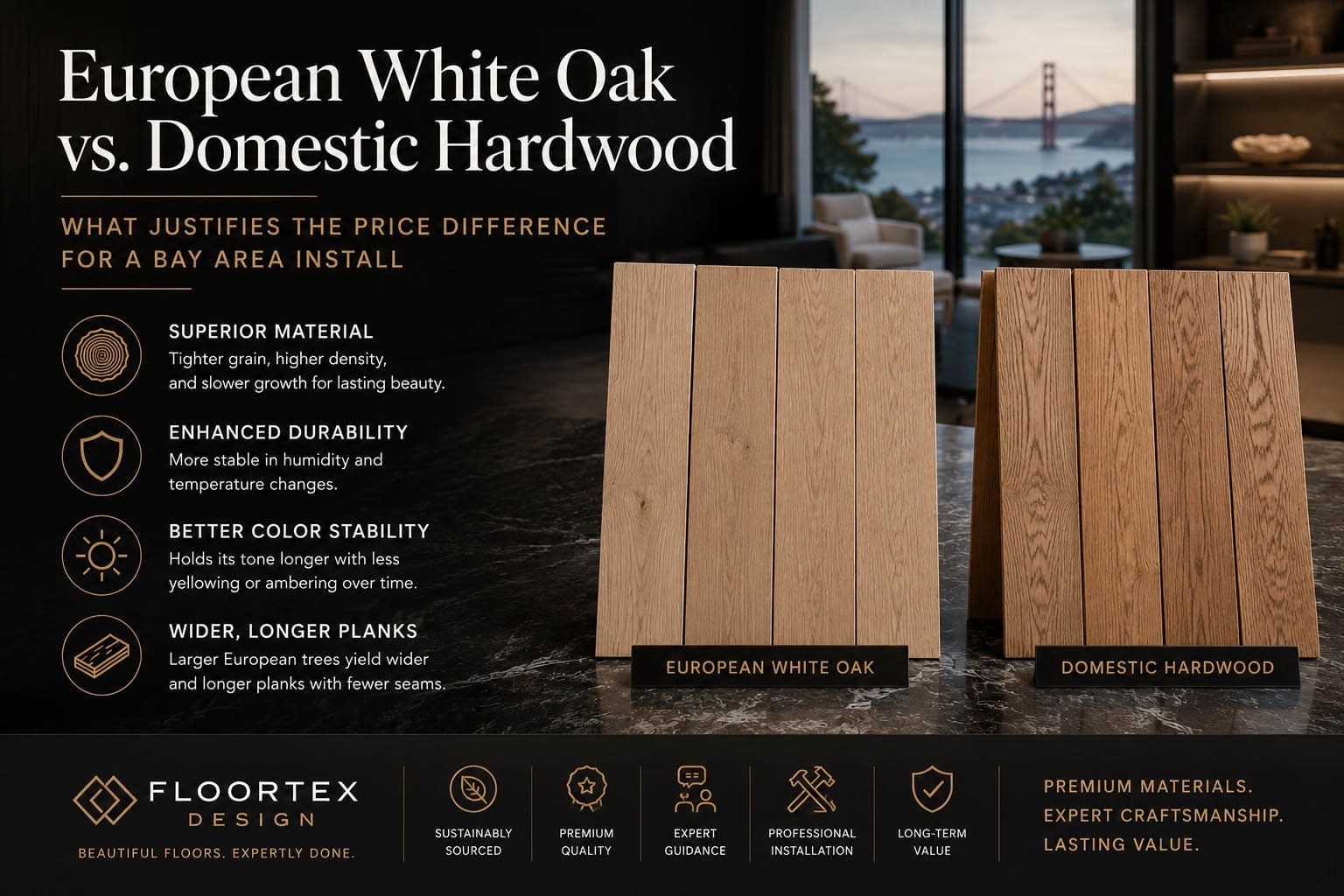
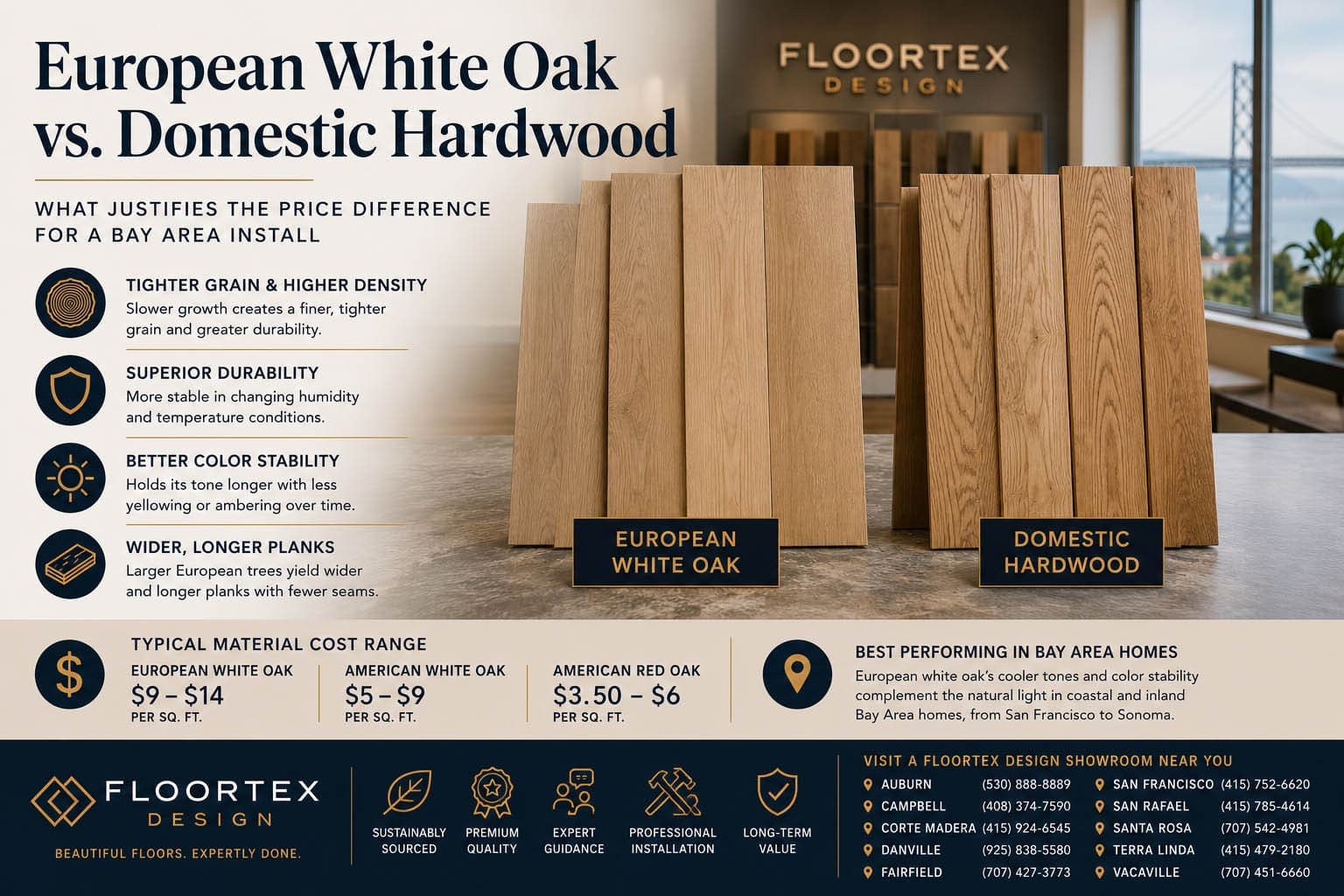
Quick answer: European white oak commands a 25 to 50 percent premium over American white oak and a 60 to 100 percent premium over American red oak, justified by tighter cellular structure, higher tannin content, more uniform color, and wider plank yields from larger European trees. For Bay Area installations, the premium is most defensible in coastal Marin, Sonoma, and San Francisco homes where the cool natural light favors European oak’s color stability and where the wider planks suit modern and transitional architecture. Expect to pay $9 to $14 per square foot for European white oak material in Select grade, compared to $5 to $9 for American white oak and $3.50 to $6 for American red oak.
The European white oak question is the single most common second-opinion call we get in our San Francisco, San Rafael, and Corte Madera showrooms. A buyer has been quoted European white oak by their designer or contractor, the price is meaningfully higher than the American oak alternative, and they want a straight answer on whether the premium is real or marketing. The answer depends on factors specific to the home, the lighting, and the buyer’s tolerance for color shift over time. This article walks through every one of them.
What is European white oak, and how is it different from American oak?
European white oak (Quercus robur and Quercus petraea) is a hardwood species grown primarily in France, Germany, Croatia, Hungary, and the Czech Republic, distinguished from American white oak (Quercus alba) by tighter grain, higher tannin content, slower growth rate, and larger mature tree diameter. The two species are botanically related but visually and structurally distinct enough that flooring specifiers treat them as separate categories.
The tighter grain comes from slower growth. European oak trees in well-managed forests grow more slowly than American white oak in the southeastern United States, which produces denser annual rings and finer figure in the lumber. The higher tannin content matters because tannins react with iron-based stains, lyes, and reactive finishes to produce the smoked, fumed, and aged looks that drive most high-end European oak demand. American white oak has tannins too, but at lower concentration; the same reactive treatment produces a milder result.
The third difference is plank yield. Mature European oak trees commonly reach 30 to 40 inches in diameter, which produces wider, longer rift-and-quartered planks than the smaller-diameter American white oak typical of commercial harvest. A 10-inch-wide rift-sawn plank in a 9 to 12 foot length is achievable in European oak in production volume. The same plank in American white oak requires hand-selection from premium-grade stock and commands a comparable price by the time you get it.
The fourth difference, less talked about but meaningful in our Bay Area installations, is color stability under UV exposure. European oak holds its tone over years of sun exposure with relatively little amber shift. American white oak ambers slightly. American red oak ambers significantly. In a south-facing Pacific Heights living room with floor-to-ceiling windows, that distinction shows up at year three and is permanent.
Why does European oak cost more than American oak?
European oak costs more for four reasons: longer transport distance and tariff exposure, slower-growth raw material with higher per-board-foot cost at the mill, stricter FSC and PEFC certification standards driving up sourcing cost, and stronger demand pressure from the global high-end residential and commercial market.
Transport is the simplest piece of the math. European oak is harvested in Europe, milled either in Europe or shipped raw to North American mills, and then distributed. The container shipping cost, import duty exposure, and currency exchange variance all add to the landed cost compared to American oak harvested and milled domestically. We have seen European oak material pricing swing 8 to 15 percent in a single year based on shipping and tariff factors alone.
The raw material cost difference is real and structural. A European oak tree in managed German or French forest grows on a 120 to 200 year rotation; the lumber harvested from those trees carries a higher per-board-foot cost than American white oak harvested on a 60 to 80 year rotation in southeastern hardwood forests. That cost difference compounds through the milling and distribution chain.
Certification is the third driver. The European oak coming into the high-end flooring market is almost entirely FSC (Forest Stewardship Council) or PEFC (Programme for the Endorsement of Forest Certification) certified, with full chain-of-custody documentation. American white oak in the commodity flooring market often is not. The certification cost itself is meaningful, and the supply of certified European oak is constrained, which adds price pressure.
The fourth driver is demand. European oak is the dominant species in high-end residential interiors across Europe, the UK, the Northeast US, the Pacific Northwest, and California. That demand pressure, combined with the slower production cycle, keeps the price firm even in market downturns. We have not seen European oak material pricing drop meaningfully even in soft remodeling cycles.
How does European oak look different in a Bay Area home?
European oak reads cooler, tighter, and more uniform than American white oak in Bay Area lighting conditions, with three visual signatures that buyers consistently respond to: a finer, more linear grain pattern, a more even base color before staining or finishing, and a stronger response to reactive and smoked finishes. The look pairs with the cool, soft natural light common to coastal California and reads particularly well in San Francisco’s marine-layer light and Marin County’s filtered coastal light.
The grain difference is the most visible. European oak’s tighter annual rings produce a finer, more linear cathedral or rift figure compared to American white oak’s more open and varied grain. In a 9-inch-wide plank, the difference is unmistakable; in a 3-inch strip, less so. We routinely walk Marin clients through side-by-side large-format samples of European and American oak in the same plank dimension and finish, and the European board reads visibly quieter and more refined.
Base color before finishing is the second signature. European oak’s heartwood runs a tighter color range, typically a soft mid-tan with subtle pink undertones. American white oak’s heartwood runs broader, from light cream to deeper amber, with more visible color variation board to board. Buyers who want a uniform floor without character grade variation almost always prefer European. Buyers who want a more lived-in, varied floor often prefer American white oak in Character grade.
Reactive finish response is the third signature, and the one that most clearly justifies the price premium for buyers who want a specific designer aesthetic. The fumed, smoked, and reactive-stained European oak floors that dominate high-end Pacific Heights, Tiburon, and Healdsburg interiors achieve their tone because of European oak’s tannin content. The same fuming process on American white oak produces a duller, less saturated result. The same process on American red oak produces an unpredictable, sometimes pinkish outcome. If a designer has shown a buyer a smoked or fumed reference image, the buyer is almost certainly looking at European oak.
What about plank size availability?
European oak is available in wider and longer planks in production volume than American white oak, which is the second major reason designers and architects specify it in modern and transitional Bay Area homes. A 7-inch-wide, 6 to 12 foot random-length plank in rift-and-quartered European oak is a stock item at most premium distributors. The same plank in American white oak is either a special order, comes from hand-selected premium stock, or simply is not available.
The size availability matters because plank size is the single biggest aesthetic variable in a contemporary high-end installation. A 9-inch-wide plank reads dramatically different from a 5-inch plank, even in the same species and finish. Designers working on open-plan modern homes, lofts, and Wine Country properties typically specify 7 to 10 inch widths, and the European oak supply chain is built to deliver those widths at scale.
There is a tradeoff. Wider planks require flatter subfloors, stricter moisture control, and more careful acclimation than narrower planks. A 9-inch-wide European oak plank installed over a marginal subfloor in a coastal Marin home will cup or gap before a 5-inch plank in the same conditions would. The wider format demands better installation. For deeper detail on plank width decisions in Bay Area homes specifically, see [Wide Plank Engineered Hardwood in Bay Area Homes: When It Works and When It Doesn’t].
Is European oak actually more durable?
European oak is roughly comparable to American white oak on the Janka hardness scale and not meaningfully different in residential use. The durability advantage that buyers sense in European oak is not about hardness; it is about dimensional stability and color stability, both of which European oak does measurably better than the American species.
Janka hardness is the standard wood density measurement, expressed in pounds-force required to embed a steel ball halfway into a sample. American white oak measures around 1,360 pounds-force. European white oak measures around 1,120 to 1,360, depending on the source forest. The two species are functionally interchangeable on the hardness axis for residential application. Both dent under stiletto heels, dropped tools, or pet claws under sustained impact. Neither is meaningfully more dent-resistant in normal use.
Dimensional stability is where European oak earns the durability reputation. The tighter grain and slower growth produce a more dimensionally stable plank that resists cupping, crowning, and gapping across humidity swings. In a coastal Marin home with significant seasonal humidity changes, a properly milled European oak plank will hold its dimensions noticeably better than a comparable American white oak plank. We have tracked this across hundreds of installations and the pattern is consistent.
Color stability is the other durability axis. European oak’s tighter cellular structure and higher tannin content produce a floor that ages with less amber shift under UV exposure than American oak. In a south-facing room with significant direct sunlight, that distinction shows up as the years pass and matters to buyers who chose a specific tone they want to preserve.
When does the European oak premium not pay off?
The European oak premium does not pay off in three situations, and we tell clients so in our consultations.
The first is a buyer who wants the rustic, varied, character-grade look. American white oak in Character or Rustic grade delivers that aesthetic better and at significantly lower cost than European oak. The visual signature European oak is known for (uniform, linear, refined) is the opposite of what a rustic character-grade install wants. A client who saw a wide-plank “barnwood-look” floor on Pinterest and asked for European oak is almost certainly looking at American oak or domestic salvage material in the reference image.
The second is a high-traffic vacation rental, short-term-rental property, or commercial application where the floor will be replaced or refinished on a planned 10 to 15 year cycle regardless of material choice. The dimensional stability and color stability advantages of European oak compound over decades. If the floor will not be in place long enough to benefit from those compounding advantages, the premium does not pay off. A high-grade American white oak engineered floor with a 4 mm wear layer will deliver effectively the same lifespan in that use case.
The third is a buyer with a tight overall budget where the European oak premium would force compromises elsewhere in the project. A $24-per-square-foot European oak floor over a marginal subfloor with skipped moisture testing and a cheap underlayment is worse than a $14-per-square-foot American white oak floor installed correctly. Material premium does not compensate for installation shortcuts. We have advised clients to step down on material to fund proper installation, and the outcomes have been better than the alternative.
See European and American oak side by side. Our Bay Area showrooms carry large-format samples of European white oak, American white oak, and rift-and-quartered domestic oak in matching widths and finishes for direct comparison. Take samples home for a week before you decide.
Auburn · (530) 888-8889 | Campbell · (408) 374-7590 | Corte Madera · (415) 924-6545 | Danville · (925) 838-5580 | Fairfield · (707) 427-3773 | San Francisco · (415) 752-6620 | San Rafael · (415) 785-4614 | Santa Rosa · (707) 542-4981 | Terra Linda · (415) 479-2180 | Vacaville · (707) 451-6660
Or schedule a free in-showroom consultation online.
How does European oak compare to American walnut and other premium species?
European oak is the dominant high-end specification in Bay Area residential interiors, but it is not the only serious option. American walnut, rift-and-quartered American white oak, and reclaimed antique heart pine each occupy specific niches and outperform European oak for specific buyers.
| Species | Material price (Select grade) | Hardness (Janka) | Best fit | Tradeoff |
|---|---|---|---|---|
| European white oak | $9 to $14 / sq ft | ~1,120 to 1,360 | Modern, transitional, reactive-finish projects | Cost premium; requires good install |
| American white oak | $5 to $9 / sq ft | ~1,360 | Character-grade rustic looks, traditional projects | Less uniform; reactive finishes less dramatic |
| Rift-and-quartered American white oak | $8 to $13 / sq ft | ~1,360 | European-oak look at lower cost | Limited width and length availability |
| American walnut | $11 to $16 / sq ft | ~1,010 | Warm contemporary, classic, traditional interiors | Softer; dents more readily |
| Reclaimed heart pine / antique oak | $14 to $30+ / sq ft | varies | Pre-1940 restorations, character-driven projects | Limited supply; longer lead times |
American walnut (Juglans nigra) reads warmer, darker, and richer than European oak and pairs with traditional, classic, and warm contemporary interiors that European oak’s cooler palette does not suit. The tradeoff: walnut is softer than oak and dents more readily under sustained impact. For an active family with kids, dogs, and dropped objects as a way of life, walnut shows more wear faster than oak.
Rift-and-quartered American white oak addresses the European-oak buyer who wants the linear, refined look but resists the European premium. The cut delivers the straight grain and dimensional stability that drive the European oak aesthetic at roughly 70 to 80 percent of European oak’s cost in comparable plank dimensions. We specify this option frequently for clients in San Rafael, Corte Madera, Mill Valley, and Healdsburg who want the look without the import premium.
Reclaimed antique heart pine, salvaged Douglas fir, and reclaimed European oak occupy a different category entirely. The boards carry visible history (nail holes, original surface character), and the aesthetic suits restoration projects in pre-1940 Bay Area homes where new material reads wrong against the architecture. We have specified reclaimed material for Pacific Heights Victorians and Berkeley Craftsmans where it was the right answer.
What grade of European oak should I choose?
European oak grade selection comes down to how much visual variation the buyer wants in the finished floor. Select grade reads cleanest, Prime grade reads close-grained and refined, Character grade shows knots and mineral streaks, and Rustic grade shows dramatic variation including sapwood and large knots.
Select grade (sometimes called AB grade in European nomenclature) is the cleanest option. Knots are minimal, color is uniform, sapwood is excluded or limited. This is the grade that suits Pacific Heights modern remodels, SoMa lofts, and any installation where the floor should read as a quiet background rather than a focal element. Pricing premium runs 10 to 25 percent over Character grade in the same product line.
Prime grade (sometimes called ABC grade) allows small tight knots and modest color variation while excluding the larger features. This is the volume grade for high-end installations and reads as refined without feeling sterile.
Character grade (CD or ABCD grade in European nomenclature) shows knots up to a specified size, mineral streaks, occasional sapwood, and visible color variation board to board. This is the grade that suits Marin and Sonoma residences where a lived-in, organic feel suits the architecture, and the grade that many of our wine country clients prefer. It reads as more residential and less commercial than Select grade.
Rustic grade allows everything: large knots, heavy sapwood, dramatic color variation, surface character. This grade is heavily specified in farmhouse and rustic-contemporary projects, particularly in Sonoma and Napa County, and reads as deliberately raw. Pricing is often comparable to or slightly below Prime grade because the milling tolerances are looser.
What finishes work best on European oak?
European oak takes a wider range of finishes well than any other species we work with, and the finish decision is often more impactful on the final aesthetic than the grade or plank size decision. The four dominant finish categories on European oak: natural oil, hard-wax oil, smoked or fumed plus oil, and reactive-stained plus oil.
Natural oil (Rubio Monocoat, Osmo Polyx, WOCA Diamond Oil, Bona Craft Oil) preserves the wood’s natural color and reads as the European oak shows in raw form: soft mid-tan, subtle pink undertones, matte to satin sheen. This is the most common finish in our high-end Bay Area installations and the one most designers default to.
Hard-wax oil delivers similar visual results to natural oil but with somewhat different surface characteristics and maintenance profile. The two categories are often used interchangeably in conversation. The functional difference is in maintenance interval and spot repair detail.
Smoked or fumed European oak is treated with ammonia vapor before finishing, which reacts with the tannins to darken the wood throughout, not just on the surface. The result is a deeper, browner, warmer tone with significant depth that no stain can fully replicate. This is the signature look of European-designed interiors and one of the strongest reasons to specify European oak rather than American. Fumed American white oak does not achieve the same depth because of the lower tannin content.
Reactive-stained European oak uses iron-based or other tannin-reactive stains to drive color changes that interact with the wood’s natural tannins. The look ranges from soft grey-brown weathered tones to deep blackened ebonized finishes. These finishes are specified frequently by designers working on contemporary Pacific Heights, Tiburon, and Healdsburg projects.
For comprehensive guidance on which finish system pays off long-term in Bay Area conditions, the finish section in [Choosing High-End Flooring for a Bay Area Home: A Buyer’s Framework for Material, Craftsmanship, and Long-Term Value] covers the full decision in context.
Frequently asked questions
Is European white oak worth the price difference over American white oak? European white oak is worth the premium for buyers who want a tighter, more uniform grain, a cooler base color, and the ability to achieve smoked, fumed, and reactive-stained finishes that American white oak cannot match. The premium is harder to justify for buyers seeking a rustic character-grade look or for short-term-hold properties where the long-term color and dimensional stability advantages do not have time to compound.
Does European oak hold up better than American oak? European oak is similar to American white oak on Janka hardness but measurably better on dimensional stability and color stability under UV exposure. In Bay Area homes with significant seasonal humidity swings or direct sun exposure, those stability advantages compound over years.
Where does European oak come from? The European oak supplied to the North American high-end flooring market is harvested primarily in France, Germany, Croatia, Hungary, and the Czech Republic, typically from FSC or PEFC certified managed forests with full chain-of-custody documentation.
Can European oak be installed over radiant heat? Yes, when specified properly. Rift-and-quartered European oak in engineered construction with appropriate core specification is one of the better species choices for radiant heat applications because of its dimensional stability. The plank construction and installation specification matter more than the species choice; not all European oak engineered products are radiant-heat-rated.
What is the difference between Select and Character grade European oak? Select grade allows minimal knots, uniform color, and limited or no sapwood. Character grade allows visible knots up to a specified size, mineral streaks, occasional sapwood, and noticeable color variation board to board. Select reads refined and quiet; Character reads lived-in and organic.
How much does European white oak flooring cost installed in San Francisco? European white oak runs $14 to $28 per square foot installed in San Francisco, Marin, and Sonoma County markets, with material at $9 to $14 per square foot for Select grade and the balance representing installation, subfloor prep, and finish work. Rift-and-quartered material runs 30 to 50 percent more than plain-sawn. These ranges reflect current Bay Area pricing and get reviewed regularly.
Is European oak sustainable? The European oak supplied to the North American high-end flooring market is largely FSC or PEFC certified, sourced from European forests managed on 120 to 200 year rotations under stricter forestry regulation than most North American or tropical hardwood sources. Verifying certification chain-of-custody at purchase is the responsibility of the buyer and the showroom.
What is fumed European oak? Fumed European oak is treated with ammonia vapor before finishing, which reacts with the wood’s tannins to darken the heartwood throughout its depth, producing a deeper, richer brown tone than surface stain can achieve. The process relies on European oak’s high tannin content; the same process on American white oak produces a milder result, and on American red oak produces an unpredictable outcome.
Ready to compare European and American oak in person?
Our Bay Area showrooms carry matched-dimension, matched-finish large-format samples of European white oak, American white oak, and rift-and-quartered domestic oak for direct comparison in your home’s actual lighting.
Schedule a free in-showroom consultation or call the location nearest you.
Auburn · (530) 888-8889
Campbell · (408) 374-7590
Corte Madera · (415) 924-6545
Danville · (925) 838-5580
Fairfield · (707) 427-3773
San Francisco · (415) 752-6620
San Rafael · (415) 785-4614
Santa Rosa · (707) 542-4981
Terra Linda · (415) 479-2180
Vacaville · (707) 451-6660


