

Choosing High-End Flooring for a Bay Area Home: A Buyer’s Framework for Material, Craftsmanship, and Long-Term Value
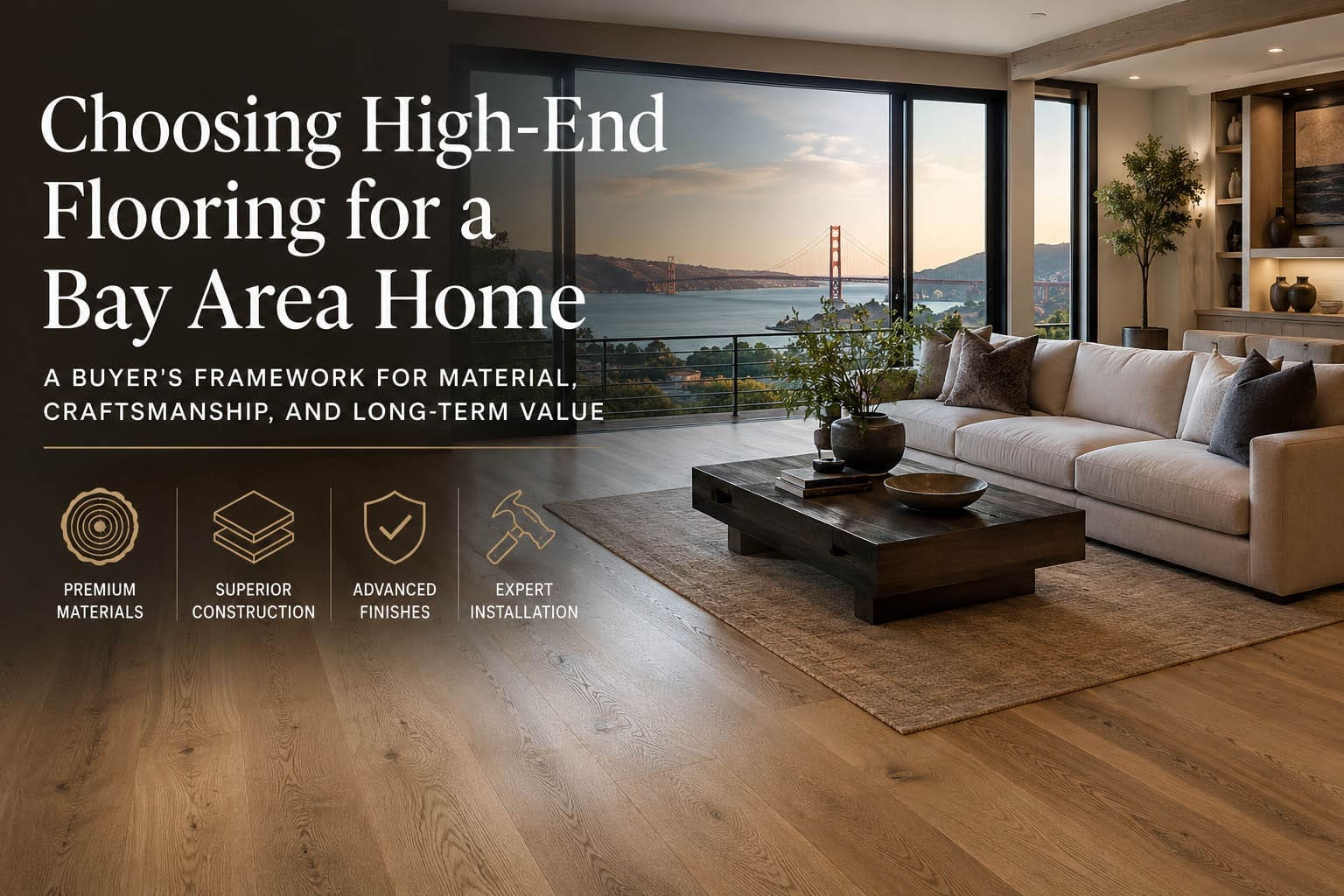
Quick answer: Choosing high-end flooring for a Bay Area home comes down to four decisions: the species and grade of material, the construction quality of the plank itself, the finish system that protects it, and the installation craftsmanship that ties it to your home. Expect to pay $14 to $28 per square foot installed for genuinely high-end engineered hardwood in San Francisco, Marin, and Sonoma County markets, with European white oak and rift-and-quartered domestic oak occupying the top tier. Material cost is roughly 40 to 55 percent of the total; the rest is labor, subfloor prep, and finish work that determines whether the floor still looks intact in fifteen years.
A high-end flooring purchase is the difference between a finished surface that anchors a home for decades and a finished surface that looks tired in five years. We have seen both outcomes, often from the same starting material, depending on the four decisions above. This article is the framework we walk our showroom clients through before they ever pull a sample.
Bay Area homes complicate the decision in ways that flooring shoppers in flatter, drier climates do not face. A 1920s Edwardian in Pacific Heights, a hillside contemporary in Tiburon, a Sonoma ranch on a slab, and a Sea Cliff Tudor with original old-growth Douglas fir subfloors are four different installations even if the buyer wants the same plank. The framework below applies to all of them. The execution does not.
What separates high-end flooring from mid-tier?
High-end flooring is defined by four measurable attributes: material grade, plank construction, finish system, and installation specification. A floor missing any one of those four sits in the mid-tier regardless of price.
Most of what gets sold as “luxury” or “designer” flooring in the Bay Area fails on at least one of the four. We see this constantly in second-opinion consultations: a client paid $18 per square foot for a product with a 1.2 mm wear layer and a factory finish that cannot be refinished, which means the floor has roughly an eight-to-twelve-year usable life before replacement. That is not a high-end purchase. That is a mid-tier purchase at a premium price.
The four attributes that matter:
| Attribute | High-end standard | Mid-tier standard | Why it matters |
|---|---|---|---|
| Wear layer (engineered) | 4 mm to 6 mm sawn-face veneer | 0.6 mm to 2 mm sliced or rotary-peeled | Determines refinishability and floor lifespan |
| Plank construction | 11 to 13 ply Baltic birch core, sawn veneer | Particle core or thin ply with sliced veneer | Dimensional stability across humidity swings |
| Finish system | UV-cured oil with replenishable surface, or factory hard-wax oil | Aluminum-oxide polyurethane (sealed, non-refinishable in spot repair) | Spot repair, sheen control, long-term aesthetics |
| Installation specification | Moisture-tested subfloor, racking pattern planned, expansion gaps per NWFA spec | Glue-and-go over whatever is there | Determines whether the floor cups, gaps, or telegraphs subfloor flaws |
The buyer who understands these four attributes can walk into any showroom in San Francisco or Marin County and evaluate a product in ten minutes. The buyer who does not is at the mercy of the salesperson.
 How do I evaluate material species and grade?
 How do I evaluate material species and grade?
Material decisions split into two parallel choices: the species (what tree the wood came from) and the grade (how the lumber was cut and selected from that tree). Both matter. Buyers typically focus on species and ignore grade, which is a mistake.
The dominant high-end species in our showrooms are European white oak, American white oak, American walnut, and rift-and-quartered domestic oak. European white oak is the volume leader in Bay Area projects because the color works with the cool, soft natural light common to coastal California and inland Wine Country alike. Its tannin content is also higher than American white oak, which affects how it takes reactive finishes and how it ages under UV exposure. European oak tends to hold its tone; American white oak tends to amber slightly over time.
Grade is a separate axis. The same tree yields Select grade (clean, minimal knots, predictable color), Character grade (visible knots, mineral streaks, more variation), and Rustic grade (heavy knots, sapwood, dramatic variation). High-end does not mean Select grade by default. Many of our Marin and Sonoma clients choose Character grade specifically because it reads as more lived-in and less commercial in a residential setting. Select grade reads cleaner and more contemporary, which suits a Pacific Heights modern remodel or a SoMa loft.
The cut of the lumber matters as much as the grade. Plain-sawn boards (the most common) show cathedral grain and are the most cost-effective. Rift-sawn boards show straight grain and are quieter visually, used in transitional and modern interiors. Quarter-sawn boards show medullary ray flecks and the most dimensional stability against cupping and crowning, which is meaningful in homes with hydronic radiant heat or in coastal Marin homes with significant seasonal humidity shifts. Rift-and-quartered material runs roughly 30 to 50 percent more per square foot than plain-sawn from the same species and grade.
For a detailed breakdown of why European oak specifically commands its price premium, see European White Oak vs. Domestic Hardwood: What Justifies the Price Difference for a Bay Area Install.
What plank construction should I look for?
Plank construction is the single most important durability decision in engineered hardwood, and the one most aggressively obscured by manufacturer marketing. The honest standard is straightforward: 11 to 13 ply Baltic birch core, sawn-face veneer of 4 mm or thicker, and total plank thickness of 5/8 inch to 3/4 inch.
Anything thinner than 4 mm of wear layer cannot be sanded and refinished. That is not an opinion. That is a physical constraint imposed by the thickness of the veneer and the depth of nail and fastener holes. A floor with a 1 mm or 2 mm wear layer is a single-use floor; when it scratches through, the only option is replacement. A floor with a 4 mm to 6 mm wear layer can be sanded two to four times across its lifespan, which extends usable life to 40 to 80 years depending on traffic and care.
Core construction matters because Bay Area homes see meaningful humidity swings. A San Francisco home near Ocean Beach lives in roughly 65 to 80 percent relative humidity year-round. A Healdsburg home swings from 30 percent in summer to 70 percent in winter rains. A particleboard or HDF-core engineered plank will telegraph that movement; an 11-ply or 13-ply Baltic birch core will not. We have pulled out three-year-old particleboard-core “luxury” installations in St. Helena because the planks cupped beyond what could be sanded flat. The clients had paid premium pricing for a product that was structurally inappropriate for the climate.
Plank length and width affect both aesthetics and stability. Wider planks (7 inches and up) read more luxurious and modern but require flatter subfloors and stricter humidity control. Longer planks (random lengths up to 10 to 12 feet) reduce the number of end joints visible in the room, which is a hallmark of high-end installations. Cheap engineered flooring uses short planks (12 to 24 inches) because the manufacturer is yielding the maximum board-feet from each log, even at the cost of aesthetics. For deeper guidance on plank width tradeoffs in Bay Area homes, see Wide Plank Engineered Hardwood in Bay Area Homes: When It Works and When It Doesn’t.
What finish system actually holds up?
Finish system determines whether spot repair is possible, how the floor ages, and how it reads underfoot and underlight. There are three serious options at the high-end tier: factory-applied hard-wax oil, UV-cured natural oil, and aluminum-oxide-fortified polyurethane.
Hard-wax oil (Rubio Monocoat, Osmo Polyx, Loba 2K Oil) penetrates the wood rather than sitting on top of it. The floor reads matte to satin, feels like wood underfoot, and is repairable in any spot at any time without sanding the entire room. The tradeoff is maintenance: a hard-wax oil floor needs a refresher coat in high-traffic areas every two to five years. Our Marin and Sonoma clients who entertain heavily and have dogs often choose this finish because the repairability outweighs the maintenance interval. Our SF condo clients who want low-maintenance often do not.
UV-cured natural oil (Bona Craft Oil, WOCA Diamond Oil) is the manufacturer-applied version of the same approach. It cures harder than hard-wax oil under UV exposure during manufacturing, which gives better initial wear resistance, but it retains the spot-repair capability. This is the dominant finish on premium European oak engineered products sold in our showrooms.
Aluminum-oxide polyurethane is the factory finish on most American mid-tier and entry-luxury engineered products. It is hard, scratch-resistant, and almost impossible to spot-repair. Once it scratches through, the only fix is full sand-and-refinish, which requires roughly 4 mm of remaining wear layer. We do not consider aluminum-oxide finish a high-end choice on its own, but it is the right call for some commercial applications and some high-traffic vacation rentals in Sonoma where ease of cleaning outranks aesthetics.
The conventional wisdom that polyurethane is more durable than oil is outdated. In terms of total floor lifespan with spot repair factored in, a hard-wax oil floor outlasts a polyurethane floor by a significant margin because the polyurethane floor reaches end-of-life when the finish fails, while the oil floor can be refreshed indefinitely.
How much does high-end flooring actually cost in the Bay Area?
High-end engineered hardwood in San Francisco, Marin County, and Sonoma County runs $14 to $28 per square foot installed for the material plus standard installation. Add $2 to $6 per square foot for subfloor prep on older homes. Add $1 to $3 per square foot for custom border, inlay, or herringbone pattern work. A 2,000 square foot whole-home installation lands between $32,000 and $60,000 all-in for a typical project.
Material itself is roughly 40 to 55 percent of that total. Installation, prep, finish work, baseboards, transitions, stair nosings, and project management make up the rest. Buyers who compare quotes by material price alone consistently misjudge what they are buying.
Variability within the range is driven by:
- Species and grade. European white oak Select grade runs $9 to $14 per square foot in material; American walnut runs $11 to $16; rift-and-quartered material adds 30 to 50 percent.
- Plank size. Wide-plank (8 inch+) and long-plank (random lengths to 10 ft) material runs 20 to 40 percent more than standard 5 to 6 inch widths in the same product line.
- Finish system. Factory hard-wax oil or UV-cured oil adds $1 to $3 per square foot over aluminum-oxide finish.
- Subfloor condition. A 1920s Edwardian in Pacific Heights with sloping joists and old-growth fir subfloors typically requires $3,000 to $8,000 in prep before the new floor goes down. A 2010 Sonoma slab requires $500 to $2,000 in moisture mitigation and leveling.
- Pattern complexity. Straight-lay installation is baseline. Herringbone runs 25 to 40 percent more in labor. Chevron, parquet, or custom inlay can double labor cost.
These ranges reflect current Bay Area pricing and get reviewed regularly as material and labor costs shift. The full pricing breakdown including line-item detail is in What High-End Flooring Actually Costs in the Bay Area: A Real Pricing Breakdown.
A quote significantly below this range from a Bay Area provider is signaling something. Sometimes it is a legitimate close-out or distressed inventory. More often it is a thinner wear layer, a lower-grade material substitution, a skipped subfloor prep step, or labor priced by a crew that will not be on the job for the duration. We have seen all four. The most common is wear-layer substitution, which is invisible at install and surfaces five to ten years later when the floor cannot be refinished.
See it in person at the showroom nearest you. Bring your floor plan, your design vision, and any architect or designer drawings to a free in-showroom consultation. Large-format sample viewing in natural light is the single most useful step in a high-end flooring decision.
Auburn · (530) 888-8889 | Campbell · (408) 374-7590 | Corte Madera · (415) 924-6545 | Danville · (925) 838-5580 | Fairfield · (707) 427-3773 | San Francisco · (415) 752-6620 | San Rafael · (415) 785-4614 | Santa Rosa · (707) 542-4981 | Terra Linda · (415) 479-2180 | Vacaville · (707) 451-6660
Or schedule a free in-showroom consultation online.
What does installation craftsmanship actually look like?
Installation craftsmanship is the variable that turns identical material into a floor that lasts forty years or a floor that fails in five. The installation specification we follow on every high-end engineered hardwood project includes seven non-negotiable steps, and we have turned away clients whose budget did not support them.
The seven steps:
- Moisture testing of the subfloor. Concrete slabs are tested via calcium chloride (ASTM F1869) or in-situ relative humidity (ASTM F2170). Wood subfloors are tested via pin or pinless moisture meter. Acceptable readings vary by product but typically fall below 4 percent moisture content for wood subfloors and below 75 percent RH for concrete.
- Subfloor flattening. Per NWFA (National Wood Flooring Association) installation specification, the subfloor must be flat within 3/16 inch over a 10 foot radius. Most Bay Area homes built before 1960 do not meet this out of the gate.
- Acclimation. Material sits in the install space for 5 to 14 days depending on product, allowing moisture content to equilibrate before installation.
- Racking layout. A skilled installer dry-lays the first three to five rows of the room to plan end-joint stagger, color and grain distribution, and transitions at doorways. Cheap installations skip this step.
- Fastening or adhesive per manufacturer specification. Nail schedule, adhesive product (Bostik, Mapei, Sika), and trowel size are specified by the flooring manufacturer; deviation voids the warranty.
- Expansion gap respect. A 1/2 inch to 3/4 inch perimeter gap is left around the room, hidden by baseboard or quarter-round. Skipping this is the single most common cause of cupping in coastal Marin and Sonoma installations.
- Transitions and finish work. Stair nosings, vent registers, door thresholds, and baseboard reinstall are integrated into the install scope rather than left to the homeowner.
A quote that does not specify these steps is a quote that does not include them. We have walked clients through second-opinion situations where the cheaper bid omitted moisture testing entirely; the floor was installed over a slab that later read 92 percent RH, and the planks cupped within eighteen months. The replacement cost exceeded the savings on the original install by a factor of three.
For high-end installations, we recommend asking your installer to specify their adherence to NWFA installation guidelines in writing. If they cannot, they are not the right installer.
How do I know if the showroom or installer I’m working with is actually qualified?
A qualified high-end flooring partner does three things differently from a big-box retailer: large-format sample lending, project management through installation, and post-install accountability. Anyone missing any of the three is not a partner; they are a vendor.
Large-format sample lending means you take a 24 inch by 36 inch (or larger) sample home for at least a week before you commit. You see it in your living room at 7 a.m., at noon, and at 9 p.m. under your actual lighting. You see it in the room it will go in, against your trim color and your furniture. A 4 inch by 6 inch chip in a showroom under fluorescent light tells you almost nothing about how the floor will read in your home. Big-box retailers do not lend large-format samples because their model is not built for it.
Project management through installation means the same point of contact who sold you the material is responsible for the installation outcome. Cheap installations split this: the retailer sells the material and refers you to “their installer,” who is a separate company with no shared accountability. When the floor cups in eighteen months, both parties point at the other. A qualified high-end showroom employs or contracts directly with the installation crew and owns the outcome.
Post-install accountability is the year-one and year-three follow-up. A high-end provider should come back and check the floor at one year and address any seasonal movement that needs attention. If the only time you hear from your flooring company after install is when they want a review, that is a vendor relationship. For detail on how to evaluate showrooms in this market specifically, see [Choosing a Flooring Showroom in the Bay Area: What Separates a Designer Resource from a Retail Box].

When is high-end flooring the wrong call?
High-end engineered hardwood is the wrong call in three situations, and we tell clients so in our consultations.
The first is a short-term hold. If you are renovating to sell within two to three years, a $20-per-square-foot floor will not return its investment over a $9-per-square-foot mid-tier engineered product in most Bay Area markets. The exception is the upper end of San Francisco, Marin, and Wine Country residential markets where high-end finish detail is part of the price expectation. If you are not in one of those segments, the return is marginal.
The second is a rental or short-term-rental property in a high-traffic Sonoma or Napa wine country location. We have advised clients to choose a high-quality LVP product over engineered hardwood for these properties because the wear pattern from rolling luggage, pet traffic, and frequent cleaning compresses the lifespan of a real wood floor faster than the rental income supports. A waterproof LVP in a wood-look visual, properly installed, is the honest answer for that use case.
The third is a household with significant pet traffic, no shoe-removal habit, and a low maintenance tolerance. Engineered hardwood is repairable, but it requires care. If the household wants a floor that takes everything and gets cleaned with a steam mop, the right call is a high-end LVP, not a $24-per-square-foot oak floor. We have turned down sales because the use case did not match the product.
These are not common situations, but they are common enough that we ask about them in every consultation.
What gets decided in the showroom versus what gets decided online?
Three decisions in a high-end flooring purchase can be made online; four cannot. Buyers who try to make all seven online consistently end up with floors they regret.
The decisions that can be made online: material species shortlist, plank construction specification, and finish system preference. These are research decisions, and reading thoroughly, watching manufacturer videos, and looking at lifestyle imagery is genuinely useful at this stage.
The decisions that cannot be made online: final color and grain selection, plank width and length appropriate to your specific room, finish sheen against your specific lighting, and pattern direction relative to your specific architecture. These are sensory decisions that require physical samples and ideally a designer or showroom consultant standing in the room with you.
We have had clients who arrived at the San Francisco showroom certain they wanted a 9-inch-wide European oak in a smoked finish, viewed the large-format sample in their Pacific Heights living room, and switched to a 7-inch rift-and-quartered American oak in a natural finish because the smoked tone fought their Bay-facing northern light. We have had Sonoma clients who switched the opposite direction after seeing the warmth a smoked finish added to a south-facing great room. The decision the article cannot make for you is the one where the sample meets the light meets the room.
Frequently asked questions
What is considered high-end flooring? High-end flooring is defined by four measurable attributes: a wear layer of 4 mm or thicker (for engineered products), a stable plank core like 11 to 13 ply Baltic birch, a serious finish system such as hard-wax oil or UV-cured natural oil, and installation that meets NWFA specifications. Premium price alone does not make a floor high-end; the construction does.
How long does high-end engineered hardwood last? A high-end engineered hardwood floor with a 4 mm to 6 mm wear layer lasts 40 to 80 years with proper care, including two to four full sand-and-refinishes across that lifespan. Floors with thinner wear layers cannot be refinished and typically reach end-of-life at 8 to 15 years.
Is European white oak worth the premium over American white oak? European white oak commands roughly a 25 to 50 percent premium over comparable American white oak, justified by tighter grain, more uniform color, higher tannin content for reactive finishes, and better dimensional stability. Whether that premium is worth it depends on the aesthetic outcome you want and the climate your home sits in. For deeper detail see our companion article on European white oak.
Can engineered hardwood be installed over radiant heat? Yes, but the plank construction must be specifically rated for radiant heat by the manufacturer, typically meaning a quarter-sawn or rift-sawn cut, a thicker engineered core, and a controlled installation moisture content. Plain-sawn wide-plank engineered hardwood over radiant heat is a common failure pattern we have seen in Marin and Sonoma installations.
How much does it cost to install high-end flooring in San Francisco? High-end engineered hardwood installed in San Francisco runs $14 to $28 per square foot installed, with additional cost for subfloor prep, pattern complexity, and custom finish work. A typical 2,000 square foot whole-home installation lands between $32,000 and $60,000. These ranges reflect current Bay Area pricing and get reviewed regularly.
Should I choose plain-sawn, rift-sawn, or quarter-sawn flooring? Plain-sawn is the cost-effective default and shows cathedral grain. Rift-sawn shows straight grain and reads more contemporary. Quarter-sawn shows medullary ray flecks and offers the best dimensional stability, which matters in homes with radiant heat or significant seasonal humidity swings. Rift-and-quartered material runs 30 to 50 percent more per square foot than plain-sawn from the same species.
Do I need to remove my old floors before installing engineered hardwood? Usually yes, though there are cases where engineered hardwood can install over an existing floor if the existing floor is stable, flat, and the total assembly height does not interfere with doors and transitions. The decision is project-specific and should be made during a subfloor assessment.
What is the most common installation mistake in Bay Area homes? The single most common mistake we see in second-opinion consultations is inadequate moisture testing of concrete slabs in homes built on grade. Bay Area slabs, particularly in Marin and Sonoma, can hold residual moisture for years. Skipping ASTM F2170 in-situ humidity testing leads to cupping, gapping, and adhesive failure that surfaces 12 to 24 months after installation.
Ready to see the materials in person? Our eight Bay Area showrooms in San Francisco, San Rafael, Corte Madera, Santa Rosa, Auburn, Vacaville, Danville, and Campbell carry the European white oak, rift-and-quartered domestic oak, and premium engineered hardwood product lines discussed in this article in large-format samples ready for at-home viewing.
Schedule a free in-showroom consultation or call the location nearest you.
Auburn · (530) 888-8889
Campbell · (408) 374-7590
Corte Madera · (415) 924-6545
Danville · (925) 838-5580
Fairfield · (707) 427-3773
San Francisco · (415) 752-6620
San Rafael · (415) 785-4614
Santa Rosa · (707) 542-4981
Terra Linda · (415) 479-2180
Vacaville · (707) 451-6660


