

Wide Plank Engineered Hardwood in Bay Area Homes: When It Works and When It Doesn’t
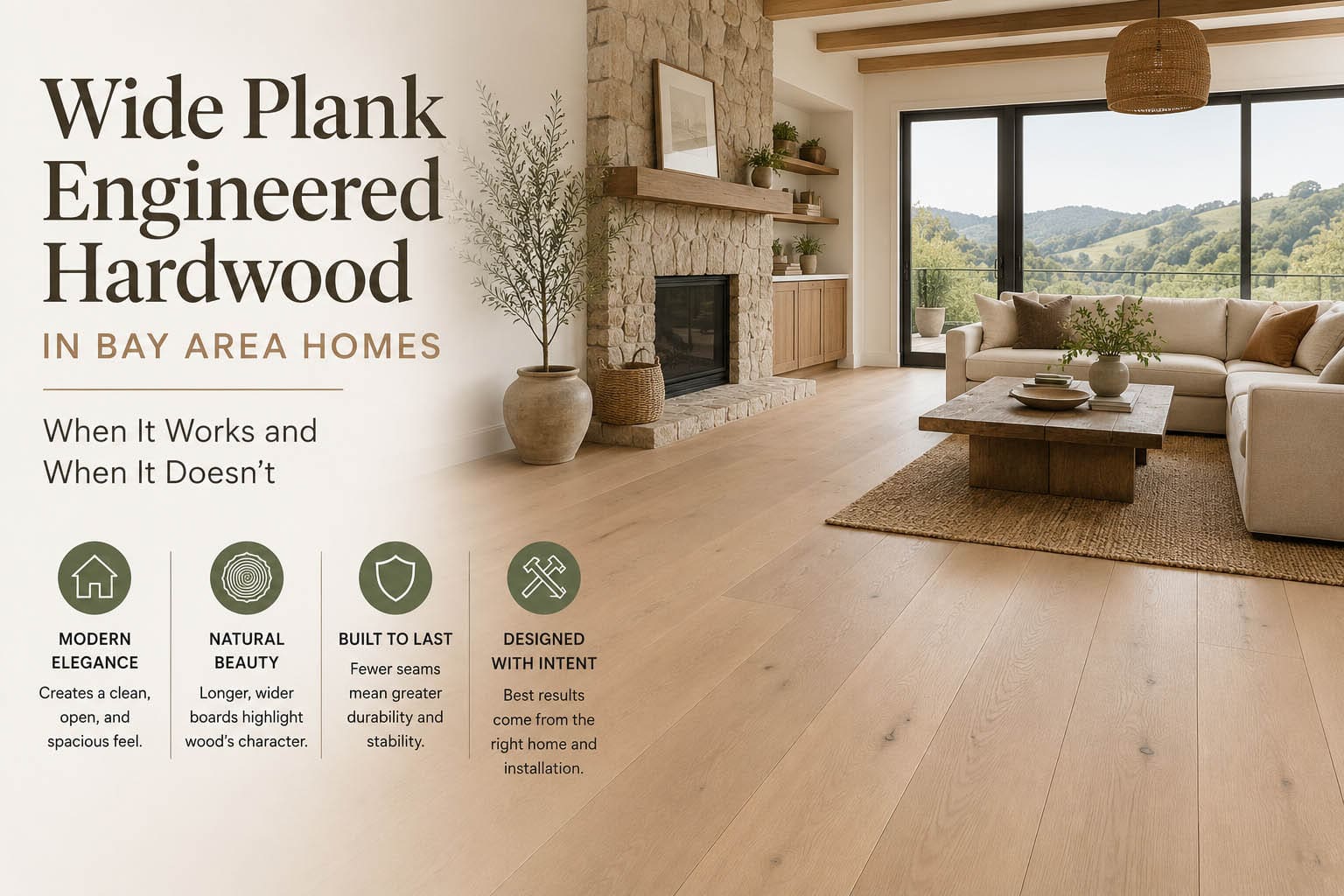
Quick answer: Wide plank engineered hardwood (planks 7 inches and wider) reads dramatically more luxurious than standard 3 to 5 inch widths and suits open-plan modern, transitional, and Wine Country interiors. The format works well in San Francisco contemporaries, Marin hillside homes, and Sonoma new construction with controlled humidity, but fights smaller rooms and fails in homes with marginal subfloors or uncontrolled moisture conditions. Expect to pay 20 to 40 percent more per square foot for wide plank versus standard widths in the same product line, plus higher prep and installation cost. The honest rule: wide plank rewards the homes that can support it and punishes the homes that cannot.
Wide plank is the format that has driven high-end residential flooring aesthetics for the past decade. Every designer portfolio, every magazine spread, every Pinterest board showing aspirational interiors features 7-inch, 9-inch, and 10-inch-wide planks. Buyers walk into our showrooms asking for “those wide boards” without knowing where the format works and where it does not. The format is excellent. It is not universal.
We have installed wide plank in Marin contemporaries, Sonoma new builds, SoMa lofts, and Pacific Heights remodels with strong results. We have also installed wide plank in coastal Tiburon homes that cupped within two years and in narrow Edwardian rooms in San Francisco where the format fought the architecture. This article is the decision framework we walk clients through before they commit.
What counts as wide plank?
Wide plank engineered hardwood is defined as plank widths of 7 inches and greater, with the dominant high-end specifications running 7, 8, 9, and 10 inches. Anything narrower than 7 inches is standard-width or narrow plank; anything wider than 10 inches enters specialty or custom territory.
The category boundaries are not strict industry standards; they are market conventions. Most flooring manufacturers organize their product lines around these widths because the supply chain, plank construction, and installation specifications shift meaningfully at each step. A 6-inch plank is sourced, milled, and installed similarly to a 5-inch plank. A 9-inch plank requires different log selection, different milling, and different installation prep.
Three width tiers occupy distinct positions in the high-end market:
- 7 to 8 inches is the volume tier for contemporary residential interiors. The look reads modern and refined without demanding the strictest install conditions. This is what we specify most often for SF condos, Marin contemporaries, and transitional projects across the Bay Area.
- 9 to 10 inches is the premium tier and the format that most strongly signals high-end specification. The visual impact in a large room is substantial. The install requirements are stricter: flatter subfloor, tighter moisture control, longer acclimation period.
- 11 inches and wider is specialty territory, often custom milled from European mills, with significantly higher cost, longer lead times, and the strictest install requirements. We specify this tier infrequently and only for projects where the architecture and client expectations justify the complexity.
For background on the broader high-end flooring decision framework, see [Choosing High-End Flooring for a Bay Area Home: A Buyer’s Framework for Material, Craftsmanship, and Long-Term Value].
Why is wide plank engineered hardwood so popular?
Wide plank dominates high-end residential design for three reasons: the visual impact suits modern open-plan architecture, the reduced number of seams reads as more luxurious, and the format aligns with how European and Pacific Northwest design trends have shaped American residential interiors over the past fifteen years.
Visual impact is the obvious driver. A 9-inch plank in a 600 square foot great room shows roughly 800 board faces. The same room in 3-inch strip shows 2,400 board faces. The wider format produces a calmer, less busy floor that lets the wood character carry the room rather than the seam pattern. In modern and transitional interiors where the floor should read as a quiet ground plane under the architecture, this matters significantly.
The seam reduction also affects how the floor ages. Fewer seams means fewer transitions where dirt collects, fewer edges where finish wear concentrates, and fewer joints where seasonal movement shows up. A well-installed wide plank floor reads cleaner at ten years than a standard-width floor in the same conditions.
The third driver is design trend influence. The wide plank aesthetic moved from European residential interiors into Pacific Northwest contemporary architecture in the 1990s and 2000s, then into California modernism through the 2010s. By the time wide plank reached mass design awareness via Instagram, Pinterest, and home magazines, the format had two decades of high-end specification behind it. The trend is now mature, not a passing fashion. Wide plank specification will continue to be the dominant high-end direction for at least the next decade based on the current trajectory of residential design.
Where does wide plank work well in Bay Area homes?
Wide plank works exceptionally well in five Bay Area home types: modern open-plan new construction, contemporary remodels with large continuous rooms, transitional homes with high ceilings, Wine Country properties with significant square footage per room, and large-footprint condominiums in San Francisco and the Peninsula.
Open-plan modern new construction is the strongest fit. Large continuous rooms, controlled moisture environments through HVAC systems, level concrete or engineered subfloors, and contemporary architecture that benefits from a calm ground plane combine to create the conditions wide plank was designed for. We have installed 9-inch and 10-inch European white oak in Tiburon contemporaries, Healdsburg new builds, and SoMa loft conversions where the format defines the interior.
Contemporary remodels in larger Bay Area homes are the second strong fit. A renovated mid-century in Mill Valley, a Pacific Heights modernization with knocked-down walls, or a Sonoma ranch with extended great room all benefit from the wide format. The remodel context typically includes subfloor leveling and moisture mitigation that the format requires anyway, and the budget supports both the premium material and the prep work.
Transitional and traditional homes with high ceilings benefit from wide plank because the room proportions support the visual scale. A 10-foot ceiling with 9-inch wide planks reads in balance. The same 9-inch plank in a 7-foot ceiling room reads top-heavy. This is geometry, not opinion.
Wine Country properties with significant square footage per room are a natural fit. A 1,200 square foot great room in a Healdsburg or St. Helena residence absorbs wide plank visually in a way that a 250 square foot dining room in a San Francisco flat does not. The format scales with the room.
Large-footprint condominiums in newer San Francisco and Peninsula buildings are the fifth fit. Newer construction typically delivers a flatter concrete substrate and controlled HVAC environment that wide plank requires, and the open-plan layouts inside contemporary condos suit the format.
Where does wide plank fight the home?
Wide plank does not suit four common Bay Area home types: pre-1940 narrow-roomed Victorians and Edwardians, hillside coastal homes with significant humidity variation and marginal subfloors, smaller condos and apartments with limited square footage per room, and Mediterranean or Spanish revival homes where the architecture calls for different flooring character.
Pre-1940 Victorians and Edwardians in San Francisco, Berkeley, and Alameda were built with narrow, segmented room layouts. A 12 foot by 14 foot Victorian parlor with original casework and a fireplace surround does not benefit from a 9-inch-wide plank; the floor fights the architecture. The same room reads correctly in 4 to 5 inch widths, which match the proportions the house was designed around. We have advised clients to step down on plank width in these homes against their initial preference, and the outcomes have been better.
Hillside coastal homes with significant seasonal humidity changes are a structural risk for wide plank. A Tiburon home perched above the bay, a Stinson Beach property exposed to marine air, or a Bolinas residence with persistent fog all experience humidity swings that compress the operating tolerance of wide plank installations. We have replaced wide plank in coastal homes where the floor cupped seasonally despite proper installation. The narrower format absorbs the same humidity variation with less visible movement.
Smaller condos and apartments with rooms under 200 square feet often look out of proportion with wide plank. The visual rule of thumb: a plank should not exceed roughly 1.5 percent of the room’s shorter dimension. A 12-foot-wide room (144 inches short dimension) supports planks up to about 2 inches at that ratio, which is too narrow for any modern aesthetic, so the practical rule loosens. But a 9-inch plank in a room less than 200 square feet typically reads out of scale.
Mediterranean, Spanish Revival, and Mission-style homes built across the Bay Area between the 1910s and 1940s feature architecture that calls for specific flooring character. Tile, terra cotta, and narrow-width quarter-sawn oak are the period-appropriate options. Wide plank in these homes reads as a renovation that fights the architecture rather than honoring it. We have specifically advised clients with Mediterranean or Spanish Revival homes in Berkeley, Oakland Hills, and Burlingame to either honor the existing character with narrower planks or commit fully to a contemporary intervention that the house architecture can support.
What plank construction does wide plank actually require?
Wide plank engineered hardwood requires a thicker, more stable plank construction than standard widths. The non-negotiable spec for serious wide plank: 11 to 13 ply Baltic birch core, sawn-face veneer of 4 mm or thicker, total plank thickness of 5/8 inch to 3/4 inch, and either rift-sawn or rift-and-quartered cut for dimensional stability.
The construction matters because wide planks are inherently less dimensionally stable than narrow planks. A piece of wood expands and contracts across its width, not its length. A 9-inch plank moves three times as much in absolute terms as a 3-inch plank in the same humidity conditions. The cheap engineered construction that gets away with a thin veneer over an HDF or particleboard core in a 5-inch plank will fail predictably in a 9-inch plank.
The cut matters too. Plain-sawn (the most common) shows cathedral grain and is the cheapest to mill. It also has the highest dimensional movement across its width. Rift-sawn shows straight grain and has roughly 30 percent less movement than plain-sawn. Quarter-sawn shows medullary ray flecks and has the least movement of any cut, roughly 40 to 50 percent less than plain-sawn. For wide plank installations in homes with humidity variation, rift-sawn or rift-and-quartered construction is the honest standard.
We have seen wide plank failures in Marin and Sonoma installations that traced specifically to plain-sawn construction in environments that demanded quarter-sawn. The plank cupped at the edges, gapped at the seams, and could not be sanded flat because the cupping exceeded the wear layer’s tolerance for material removal. The replacement cost exceeded the original install cost by 40 percent because the failed material had to be removed and disposed of in addition to the new install.
A wide plank product without 4 mm of wear layer is a single-use floor. When that floor scratches through, no sand-and-refinish is possible, and the only option is full replacement. We do not specify wide plank with less than 4 mm wear layer for any high-end project. The combination of wide format, premium price, and short usable life does not serve the client.
What about subfloor and installation requirements?
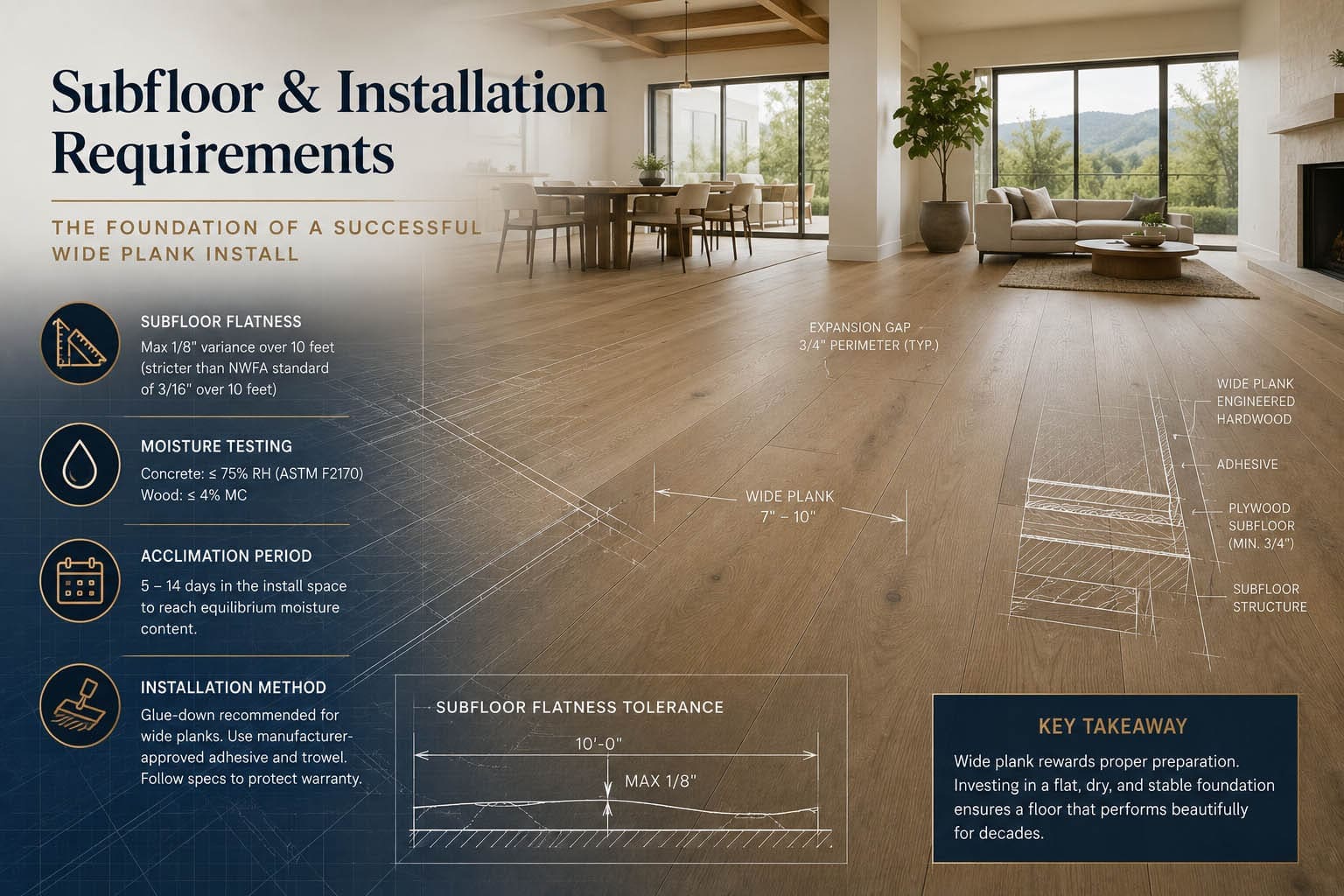
Wide plank installation requires a flatter subfloor, longer acclimation period, stricter moisture testing, and tighter installation specification than standard-width plank. The NWFA (National Wood Flooring Association) specification for engineered hardwood requires the subfloor to be flat within 3/16 inch over a 10 foot radius. For wide plank installations in humidity-variable environments, we tighten this to 1/8 inch over 10 feet.
Subfloor preparation in older Bay Area homes is the single biggest hidden cost driver in wide plank installations. A 1920s Pacific Heights Edwardian with old-growth Douglas fir subfloors will typically require $3,000 to $8,000 in leveling and prep before wide plank can be installed. The original subfloor was never built for the tolerances wide plank demands. We have walked clients through this cost line in pre-install consultations and have had clients reduce plank width to absorb the savings into the project elsewhere.
Moisture testing is non-negotiable. Concrete slabs need to be tested via either calcium chloride (ASTM F1869) or in-situ relative humidity (ASTM F2170) and must read below the manufacturer’s specified threshold, typically 75 percent RH for engineered hardwood. Wood subfloors need to be tested with a pin or pinless moisture meter and must read below 4 percent moisture content for most products. Bay Area slabs in particular, including Marin and Sonoma installations on grade, can hold residual moisture for years and require this testing.
Acclimation matters more for wide plank than for narrow. The material needs 5 to 14 days in the install space to reach equilibrium moisture content before installation begins. Skipping this step is the most common installation shortcut on cheap jobs and the most common cause of seasonal cupping in the first year. We have audited failed wide plank installations where the material was unloaded one day and installed the next; the floor cupped within four months as the wood equilibrated against the home environment.
The fastening or adhesive specification is set by the manufacturer and is typically stricter for wide plank than narrow. Glue-down installations are common for wide plank because nail-down loosens at the edges of wide boards faster than narrow. Specific adhesive products (Bostik, Mapei, Sika) at specified trowel sizes are required. Deviation from the manufacturer’s specification voids the warranty on most premium wide plank products.
Talk to a flooring specialist about your specific home. Wide plank decisions depend heavily on your home’s age, subfloor condition, room dimensions, and humidity environment. Bring photos, dimensions, and floor plans to a free in-showroom consultation. We will tell you honestly whether wide plank is right for your project or whether a narrower format will serve you better.
Auburn · (530) 888-8889 | Campbell · (408) 374-7590 | Corte Madera · (415) 924-6545 | Danville · (925) 838-5580 | Fairfield · (707) 427-3773 | San Francisco · (415) 752-6620 | San Rafael · (415) 785-4614 | Santa Rosa · (707) 542-4981 | Terra Linda · (415) 479-2180 | Vacaville · (707) 451-6660
How much more does wide plank cost?
Wide plank engineered hardwood runs 20 to 40 percent more per square foot than standard 5 to 6 inch widths in the same product line, with material at $11 to $18 per square foot for European white oak in 7 to 9 inch widths and $14 to $24 per square foot for 10 inch and wider widths. Add installation, subfloor prep, and finish work to land at $18 to $32 per square foot installed for a typical high-end wide plank specification in San Francisco, Marin, and Sonoma County.
The material premium reflects several real cost drivers: larger logs required to yield wider planks at acceptable grade, lower board-feet yield per log due to wider cuts, longer drying and acclimation times in the mill, and tighter grading standards because defects show more visibly in wider boards. None of these are arbitrary pricing. The cost is the cost.
| Plank width | Material cost (European white oak, Select grade) | Installed cost range (Bay Area) | Best fit |
|---|---|---|---|
| 5 to 6 inches | $7 to $11 / sq ft | $14 to $22 / sq ft | Traditional and transitional homes, smaller rooms |
| 7 to 8 inches | $9 to $14 / sq ft | $16 to $26 / sq ft | Contemporary and transitional homes, mid-size rooms |
| 9 to 10 inches | $12 to $18 / sq ft | $20 to $30 / sq ft | Modern open-plan homes, large rooms, new construction |
| 11 inches and wider | $16 to $24+ / sq ft | $24 to $36+ / sq ft | Specialty modern, custom milled, large continuous spaces |
Installation cost rises with plank width for several reasons. The larger planks require two-person handling. Subfloor prep is more demanding. Adhesive consumption is higher per square foot. Cutting waste is higher because shorter scrap pieces have fewer applications. Add roughly 15 to 25 percent to installation labor for 9-inch and wider plank versus 5-inch and 6-inch plank in the same project conditions.
These ranges reflect current Bay Area pricing and get reviewed regularly as material and labor costs shift. For a comprehensive breakdown of all-in flooring costs in the Bay Area, see [What High-End Flooring Actually Costs in the Bay Area: A Real Pricing Breakdown].
Can wide plank be installed over radiant heat?
Wide plank engineered hardwood can be installed over radiant heat, but the plank construction, species, cut, and installation must all be specified for radiant use. The default wide plank product on a showroom display is typically not rated for radiant heat without verification.
Radiant heat installations require quarter-sawn or rift-and-quartered cut construction for dimensional stability under the temperature cycling that radiant systems produce. Plain-sawn wide plank over radiant heat is a predictable failure pattern; the boards cup, gap, and check across the first heating season. We have replaced wide plank in Healdsburg and Mill Valley installations where plain-sawn material was installed over radiant heat against manufacturer specification.
The plank thickness and core construction matter for thermal transfer. A 3/4-inch-thick plank insulates more than a 5/8-inch plank, which reduces heating system efficiency. Most radiant heat installations specify 5/8-inch total thickness or slightly less. The core needs to handle thermal cycling without delamination; 11-ply or 13-ply Baltic birch handles this well, while HDF and particleboard cores do not.
Installation moisture content control is stricter for radiant heat than ambient installation. The subfloor temperature should be ramped up gradually before and after installation per the radiant system manufacturer’s protocol, typically 5 to 7 days of controlled warming and cooling cycles around the install. Skipping this step is a common shortcut on tight project schedules and a common cause of first-season failures.
Some manufacturers specifically rate certain product lines for radiant heat. Asking for the manufacturer’s radiant-heat-rated product line and reviewing their installation specification in writing is the right approach. A general wide plank product installed over radiant heat without this verification is a warranty risk and a performance risk.
How do I choose the right wide plank width for my room?
Wide plank width selection should follow three rules: match the plank width to the room scale, match the plank to the architectural style, and pull samples in the actual room before committing. The single biggest regret we see in second-opinion consultations is wide plank chosen by width preference rather than room fit.
Room scale matters because plank width reads differently against different room dimensions. A 9-inch plank in a 1,000 square foot great room reads in balance. The same plank in a 200 square foot bedroom reads heavy. The rough guideline: rooms larger than 600 square feet absorb 9-inch and 10-inch widths well. Rooms 300 to 600 square feet typically suit 7-inch to 8-inch widths. Rooms under 300 square feet usually read better in 5-inch to 7-inch widths.
Architectural style is the second filter. Modern open-plan homes suit wider widths. Traditional and classic homes typically suit 5 to 7 inch widths in plain-sawn or rift-sawn cuts. Mediterranean, Spanish Revival, and Mission-style homes suit narrower widths in period-appropriate cuts. Mid-century modern homes suit 5 to 7 inch widths in clean cuts that match the period vocabulary.
Sample viewing in the actual room is the non-negotiable last step. We provide large-format samples (24 by 36 inches or larger) to clients before any commitment. The sample needs to sit in the room at multiple times of day, against the trim, against the cabinetry, in the actual lighting. A 4 by 6 inch chip in a showroom under fluorescent light cannot answer the width question reliably.
We have had clients certain they wanted 10-inch-wide European oak, viewed the sample in their Pacific Heights condo, and switched to 7-inch after seeing how the wider plank fought their room scale. We have had Sonoma new-build clients who tested 7-inch and decided to step up to 9-inch after seeing how the wider format anchored their larger spaces. The sample answers the question the article cannot.
When is wide plank the wrong call?
Wide plank engineered hardwood is the wrong call in three specific situations, regardless of how much the client wants it.
The first is a pre-1940 home with small segmented rooms and original architectural character intact. A Victorian parlor, an Edwardian dining room, or a Spanish Revival living room with original casework and proportions does not benefit from wide plank. The format fights the architecture and the floor reads as a renovation imposed on the house. We have advised Pacific Heights, Alameda, and Berkeley clients with intact period homes to specify narrower formats that honor the original character, and the outcomes have been better than the wide plank specifications would have produced.
The second is a coastal home with significant humidity variation, marginal subfloor condition, or both. A Stinson Beach property, a Bolinas residence, a Pacifica home exposed to persistent marine layer all face seasonal humidity swings that compress the operating tolerance of wide plank installations. The narrower format absorbs the same humidity with less visible movement. We have specified 5-inch to 6-inch plank in homes where the client initially asked for 9-inch, and the floors have held up significantly better than the wider format would have.
The third is a tight overall budget where the wide plank premium would force compromises on plank construction, wear layer, or installation quality. A $14-per-square-foot wide plank product with a 2 mm wear layer is worse than a $9-per-square-foot 5-inch plank with a 4 mm wear layer. Width is one variable; durability is another. We have advised clients to step down on width to fund proper plank construction, and the long-term outcome has been better.
These situations are not common in our high-end clientele, but they are common enough that we test for them in every consultation.
Frequently asked questions
What is the most common wide plank flooring width? The most common wide plank widths in high-end residential specification are 7 inches and 9 inches. 7-inch reads as modern and refined without demanding the strictest install conditions. 9-inch reads more dramatically luxurious and is the dominant specification in open-plan modern interiors.
How wide can engineered hardwood planks go? Engineered hardwood planks are available up to 14 inches wide in specialty products, though anything above 10 inches enters custom and special-order territory with longer lead times and stricter installation requirements. Most premium product lines top out at 10 to 12 inches.
Does wide plank flooring make a room look bigger or smaller? Wide plank reduces the visual seam pattern, which makes a room read calmer and less busy, an effect that suggests more spaciousness in proportion. The format does not literally make a small room look larger; it reads correctly in larger rooms and out of scale in smaller rooms.
Is wide plank flooring durable? Wide plank is as durable as standard-width flooring when specified correctly: 4 mm wear layer or thicker, 11-ply or 13-ply Baltic birch core, rift-sawn or quarter-sawn cut for dimensional stability. Cheap wide plank with thin veneer over an unstable core fails predictably in humidity-variable environments.
Can wide plank be installed over an existing floor? Sometimes, but the existing floor must be flat within tighter tolerances than narrower planks require, the moisture content must be tested and verified, and the total assembly height needs to clear doors and transitions. In older Bay Area homes the existing floor typically needs to come up before wide plank goes down.
Does wide plank cost significantly more than standard widths? Wide plank runs 20 to 40 percent more per square foot than standard 5 to 6 inch widths in the same product line, plus higher installation cost. Total installed cost for high-end wide plank in San Francisco, Marin, and Sonoma typically runs $18 to $32 per square foot. These ranges reflect current Bay Area pricing and get reviewed regularly.
Does wide plank work in small rooms? Wide plank typically reads out of scale in rooms under 300 square feet. Smaller rooms generally suit 5 to 7 inch widths. The rule is not absolute, but the visual proportion question matters more than the format preference in small-room specifications.
Why does wide plank cup more than narrow plank? Wood expands and contracts across its width, not its length. A 9-inch plank moves three times as much in absolute terms as a 3-inch plank in the same humidity conditions. Without proper rift-sawn or quarter-sawn construction, controlled moisture environment, and correct installation, wide plank cups more visibly than narrow plank.
Ready to see wide plank samples in your actual room?
Our Bay Area showrooms carry large-format wide plank samples in 7-inch, 9-inch, and 10-inch widths across multiple species and finishes, available for at-home viewing before you commit.
Schedule a free in-showroom consultation or call the location nearest you.
Auburn · (530) 888-8889
Campbell · (408) 374-7590
Corte Madera · (415) 924-6545
Danville · (925) 838-5580
Fairfield · (707) 427-3773
San Francisco · (415) 752-6620
San Rafael · (415) 785-4614
Santa Rosa · (707) 542-4981
Terra Linda · (415) 479-2180
Vacaville · (707) 451-6660


